Climate change will bring warmer winters, scorching summers to Lansing
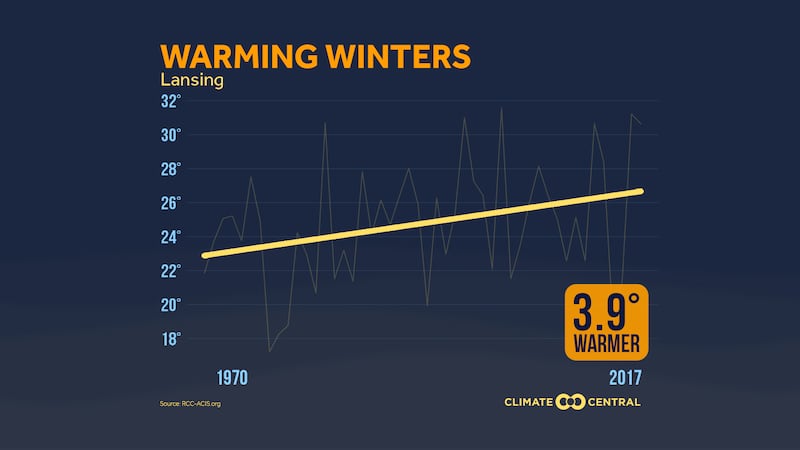
Winter in Lansing is shrinking.
It may not feel that way as near-freezing temperatures accompany the official start of winter Friday, but a hotter future is coming. As the 2000s turn into the 2100s, researchers say climate change will have an increasingly serious impact on Lansing’s and Michigan’s weather and climate. By the end of the century, winters will be mild, summers will feel tropical and the state may lose thousands of jobs.
The first sign of a changing climate is already here: Winter snow is turning into rain. Seventy-eight percent of weather stations across the state have gotten more rain and less snow since 1949, according to a
by climate change research group Climate Central.
The problem is that winter is starting later and ending sooner, says Sean Sublette, a meteorologist for Climate Central’s locality-specific resource program, Climate Matters.
“There’s not a dramatic drop (in Michigan snowfall) in the heart of winter,” he said, “but winter is shrinking.”
Alpena, for example, has lost half its November and March snowpack in the last 100 years.
Michigan’s decrease in snow is the most among Great Lakes states and seventh-most in the country. Meanwhile, Lansing’s decrease in snow ranks ninth in the U.S. out of the more than 2,000 weather stations studied from 42 states.
This trend will continue, researchers say, as air temperatures increase. The average winter temperature has risen 3.9 degrees Fahrenheit in Lansing since 1970, and more than four degrees statewide,
. Winter is by far the season warming the most. Michigan winter temperatures are increasing more than a degree than fall and two degrees than spring or summer.
By the end of the century, winter in Michigan will feel more like winter in the American South. Lansing currently experiences 142 nights per year with below-freezing temperatures. By 2100,
, the current total in High Point, N.C.

Though bitter winters turning mild may sound pleasing, the temperature changes are poised to take a significant toll on the state’s winter economy. Climate Central predicts
supported by winter tourism.
Activities like skiing, snowboarding, snowmobiling and ice fishing will be “a lot less common and a lot less economically viable,” Sublette said.
“There will still be snow,” he says, “it just won’t last nearly as long.”
As winters continue to warm, Michigan’s winter economy will gradually feel the heat.
“From decade to decade, you’ll start to notice something,” Sublette said.
Warmer winters will also mean warmer (and longer) summers. Though Michigan boasts some of the mildest summers in the country, only in upper Michigan will warmer winters “outweigh the cost of hotter summers,” according to the federal government’s annual
released last month.
Summer in Lansing will feel like summer in North Fort Myers, Fla., by 2100, Climate Central
. If current greenhouse gas emission trends continue, the average summer high temperature in the capital city will climb from 80 to 91 degrees.

“It’s going to be more consistently hot and humid,” Sublette said. In cities like Lansing, he worries about the ‘heat island’ effect, in which manmade surfaces trap the day’s heat and don’t allow the city to cool off at night like in rural areas.
And Lansing will not heat up alone. By 2100, summers in Grand Rapids will feel like summers in Tampa Bay, Detroit will feel like north Texas and Kalamazoo will feel like south Texas.
Increased humidity will couple with high temperatures to produce unprecedented heat index readings. Lansing’s average number of ‘extreme caution days’ (in which the heat index tops 90 degrees) will rise from 21 days to 63
. Even worse, the average number of ‘danger days’ (in which the heat index reaches 105 degrees) will be 20. It’s currently zero.
“That’s when the body starts to suffer from heat exhaustion, and even worse, heat stroke,” Sublette said. He adds that pollen season will last longer, which will increase allergy suffering and send more people to the hospital.
Michigan’s crops will also suffer increased attacks from usual pests, as well as non-native species that will move north from an oppressive American Southeast. Michigan’s reliably cold winters usually keep away pests like ticks, mosquitoes and weeds, but as winters warm, “more are going to survive,” Sublette says.
Though he is not a policymaker, Sublette and his fellow climate researchers suggest industries and individuals work their way off fossil fuels to tackle dangerous future warming.
"Renewable energy is one solution that has widespread support,” he said.